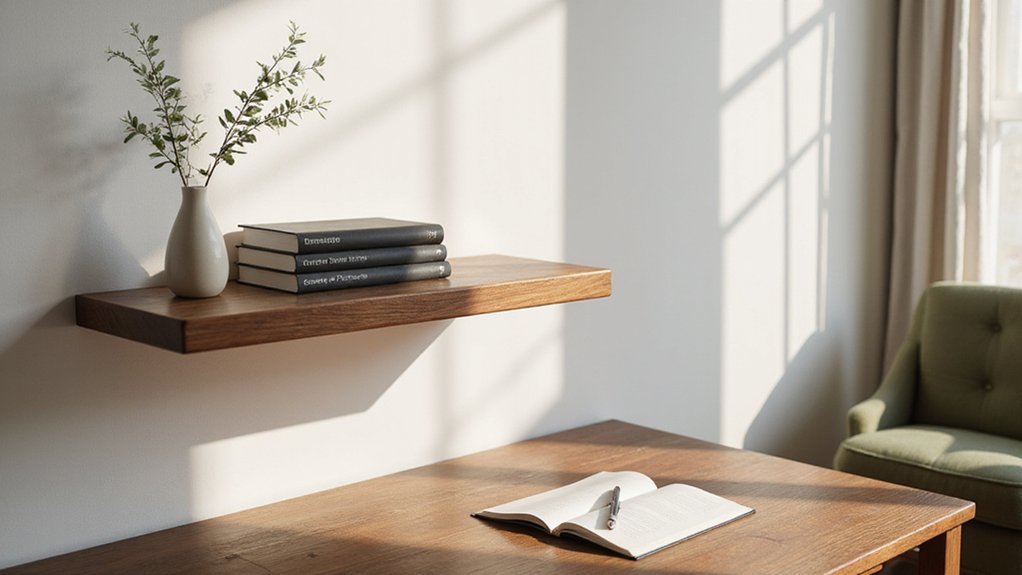
Wondering how much weight your floating shelf can hold without risking a fall? The secret lies in how and where it’s mounted. Typically, anchoring into studs provides the strongest support, with each stud holding about 50 pounds.
The shelf’s material and length also play a role. Keep reading to learn exactly how to maximize your shelf’s load capacity safely.
The 50-Pound Rule: Your Studs Do the Heavy Lifting
Because your studs support the weight, the 50-pound rule provides a straightforward way to estimate a floating shelf’s capacity. Each stud you secure your bracket to can support about 50 lbs safely, regardless of the shelf’s length or depth. Installing your brackets into two studs yields a total support of 100 lbs, making it ideal for sturdy storage without compromising the shelf’s appearance. You don’t need to worry about the material or dimensions of the shelf itself—just focus on hitting studs. If you are unsure where the studs are, a stud finder can help you locate them with precision. Adding a third stud increases the capacity to 150 lbs. Keep in mind, a short shelf on two studs can hold the same weight as a longer one on the same studs. Avoid drywall anchors—they are unreliable for heavy loads. Instead, always secure your brackets into solid wood for dependable support. This rule of thumb helps you plan your load capacity with confidence, ensuring your display remains both attractive and stable. For a similar approach to storage, consider organizing your pots and pans with practical methods that rely on proper support for lasting results. Applying the same principle to built-in bookcases can help you arrange heavy books and decor without risking damage.
Does Shelf Material Affect Floating Shelf Weight Capacity?
Shelf material significantly influences how much weight your floating shelf can support. Solid hardwoods like oak typically support 45 to 60 pounds per foot, thanks to their dense composition and durability. MDF, on the other hand, maxes out at 20 to 30 pounds per foot and can sag under heavier loads within a few months. Particleboard, often chosen for its aesthetic appeal, is even more prone to sagging and failure under strain. For higher strength and longevity, consider hybrid designs with metal frames, which can support between 65 and 85 pounds per foot without bending. When selecting material, remember that both density and thickness matter: thicker plywood at 1.25 inches supports moderate weights well, while tempered glass works best for lightweight displays. Figuring out how to organize a small closet efficiently can also benefit from choosing lightweight materials that reduce shelf strain. Choosing the right material involves balancing aesthetic preferences with structural capacity to prevent sagging or failure over time. For those seeking kitchen storage solutions, kitchen cabinets with plate racks offer a dedicated alternative that distributes weight evenly through reinforced frames. Using solid hardwoods in closets or shelves can also prevent long-term sagging when storing heavier folded items.
Why Shelf Length and Depth Change the Safe Weight Limit
Increasing shelf length or depth reduces the safe weight limit more than you might expect. Longer spans are prone to mid-span deflection, even if you attach the shelf properly to studs. For example, a 36-inch shelf made of 3/4-inch plywood can support only about 20 to 30 pounds, whereas a 24-inch span can handle 30 to 40 pounds. When spans exceed 72 inches, you should add a hidden center bracket to prevent sagging under weight. Pre-drilling precise shelf pin holes ensures the bracket aligns perfectly with the studs for maximum load transfer. For those organizing countertop items, a 3-tier shelf design distributes weight across multiple levels to prevent overloading a single span. For bookshelf beds, the frame must similarly distribute weight across multiple support points to avoid sagging over long spans.
Shelf depth creates a lever arm effect, meaning deeper shelves buckle more easily under less weight. To keep your shelves sturdy, you need to adjust the clamping and attachment points according to the span. For longer shelves, more studs are necessary to distribute the load evenly.
For decorative purposes, keep items lightweight and spread out to avoid exceeding recommended weight limits. Stacking a dense row of hardcover books can quickly surpass your shelf’s capacity. Remember, material thickness helps but does not override physics—using at least 1.25-inch thick wood is recommended for any length to ensure strength and safety.
Drywall Anchors: Why They Hold Only 20 Pounds on Floating Shelves
Drywall anchors rated for 20 to 25 pounds under a straight downward pull typically cannot be trusted for floating shelves. The reason is that the physics of cantilever loads introduces outward forces that create leverage, significantly increasing stress on the anchor. These forces can reduce the effective holding capacity by up to 75 percent. For example, a 20-pound rated anchor might only safely support about 5 pounds once the shelf extends outward. Material compatibility also plays a role; plastic expansion anchors often max out around 10 to 25 pounds, while threaded drywall anchors or molly bolts can hold more if your drywall is thick enough. Using proper anchoring techniques, such as careful drilling to avoid gypsum blowout, is essential. It’s also important to leave a safety margin of at least 20 percent below the rated capacity of the anchor. Remember that while multiple anchors can help distribute the load, they do not increase the total weight the shelf can safely hold. For improved stability, consider arranging heavier items toward the back of the shelf, similar to how freezer drawers benefit from strategic placement of dense food storage.
How to Find and Use Wall Studs for Maximum Capacity
To find wall studs for maximum support, start with a reliable stud finder or a strong magnet. Calibrate your electronic stud finder according to the manufacturer’s instructions before use. Scan the wall horizontally, moving steady and slow to detect the studs behind the drywall. Alternatively, a rare earth magnet can be used to locate the screws or nails embedded in the studs—place the magnet along the wall and watch for it to be pulled toward metal fasteners.
You can also look for clues like outlets, switch plates, or baseboard nails, which are often attached directly into studs. Tapping the wall with a hammer or your knuckles helps identify stud locations by sound: a dull, solid thud indicates wood, while a hollow echo suggests space between studs. Remember that standard spacing is usually 16 or 24 inches apart on center, so once you find one stud, measure out accordingly to locate others. For shelves that need to hold heavier items, you can increase capacity by installing wood blocking between studs for added support.
Verify their vertical alignment to avoid diagonal studs or misaligned framing. Attaching brackets or mounting hardware directly into one stud supports up to 50 pounds, but for heavier loads, securing to two or more studs increases capacity up to 100 or even 150 pounds. For maximum support, consider cutting into the drywall and installing wood blocking or anchoring directly into the wall framing, bypassing insulation and paint for a truly secure hold. When securing brackets to studs, using a self-centering doweling jig ensures perfect, straight holes for maximum stability.
Floating Shelves for Heavy Items: Garages, Pantries, and Gym Gear
Heavy-duty floating shelves are built to support substantial weight, making them ideal for garages, pantries, and gyms. Garage shelves with heavy-gauge steel can hold up to 2,000 pounds per shelf, suitable for automotive parts or workout equipment. Ventilated steel shelves in pantries typically support between 350 and 1,500 pounds each when weight is evenly distributed. Gym racks made from powder-coated steel can handle up to 2,200 pounds, accommodating weighted training gear. These shelves are much stronger than lightweight metal options designed for decorative purposes, which usually only support about 10 pounds. To ensure stability, install these shelves on 2×4 studs with vertical support legs. For very heavy loads, using top wall anchor hooks can further secure the shelf to the framing. Many models also offer sleek designs that blend into your space without sacrificing functionality. To keep heavier items accessible, consider using reusable bag storage techniques to organize smaller gear on these shelves. A FLEXIMOUNTS 2-pack of such shelves, for example, uses alloy steel construction to guarantee durability and strength. When replacing a shelf, always verify the wall studs are properly aligned to maximize weight capacity.
What Happens When You Exceed Floating Shelf Weight Capacity?
Exceeding the weight capacity of a floating shelf causes immediate visible sagging, which compromises its appearance. The surface material—whether wood, MDF, or another composite—may bow, crack, or split over time, especially under repeated stress. As the shelf strains, the mounting hardware endures increased pressure, leading to screw pulls from the wall studs or failure of drywall anchors. This weakens the entire support system, often resulting in the shelf detaching and collapsing. A falling shelf can damage flooring, furniture, or electronics positioned below, and poses a serious safety risk to anyone nearby, especially children or pets. Repair costs can quickly add up, including drywall patching, replacing damaged shelving, and reinstalling brackets or supports. To prevent these issues, it’s essential to adhere strictly to the manufacturer’s weight limits for your floating shelf. For lightweight kitchen items, practical storage ideas from countertop organizing guides can help distribute load safely.
Real Manufacturer Specs: How Hovr, Shelfology, and Forever Joint Tops Compare
Hovr offers a maximum weight capacity of 300 pounds at both 8-inch and 10-inch depths. This high capacity is due to its use of 6063 T6 aircraft-grade aluminum and an interlocking tongue-and-groove design, making it over 13 times stronger than standard brackets. Most competitors do not specify weight limits, so Hovr provides a reliable benchmark for heavy-duty applications, especially when corner mounting where stress points increase. If safe, measurable load capacity is your priority, choosing a system like Hovr with published weight limits is essential to avoid risking your shelf’s integrity. The brackets are designed to distribute weight evenly along their length, preventing sag or wobble over time, relying on a concealed support system that maintains aesthetic appeal while ensuring stability for various shelf thicknesses. For those building their own shelves, following a step-by-step build guide can help ensure the mounting structure matches the bracket’s strength.
How to Confirm Your Floating Shelf Weight Capacity Installation
To confirm your floating shelf’s weight capacity, ensure the brackets attach to at least two wall studs, each capable of supporting up to 50 pounds. Use a stud finder to mark the centers of 16-inch spaced studs for accurate placement. A mount spanning two studs can hold between 90 and 100 pounds, while attaching to three studs increases support to 135 and 150 pounds. Avoid relying on drywall anchors for heavy loads—they typically hold only about 20 pounds. For stone walls, however, you may need to use specialized masonry anchors instead of standard studs to achieve similar support. Hidden brackets create the appearance of floating shelves while brackets are attached directly to studs for stability.
Distribute decorative items evenly across the shelf to prevent concentrated weight in one area. Color coordination can aid in organizing heavier pieces near the studs, but it doesn’t impact the overall load capacity. Carefully slide the shelf onto the brackets and verify it’s level. Secure the shelf with screws and apply wood glue for added stability. Use a rubber mallet to gently tap the shelf flush, ensuring no undue stress points develop. Always calculate the total weight capacity by multiplying 50 pounds by the number of attached studs before adding items to your shelf.